
A month ago, our Lisa Halverstadt wondered what the county would do about the new state law, SB 43. The law expands the definition of reasons officials can involuntarily detain someone who can’t take care of themselves. It now includes substance abuse disorders.
Hospital leaders pressured county leaders to take advantage of the grace period – the state is allowing counties two years to implement the law. Hospitals fear that police will vastly increase the number of detentions they make and then bring them to emergency departments. They’re emergency departments that already can’t handle the patients, many homeless, they get now.
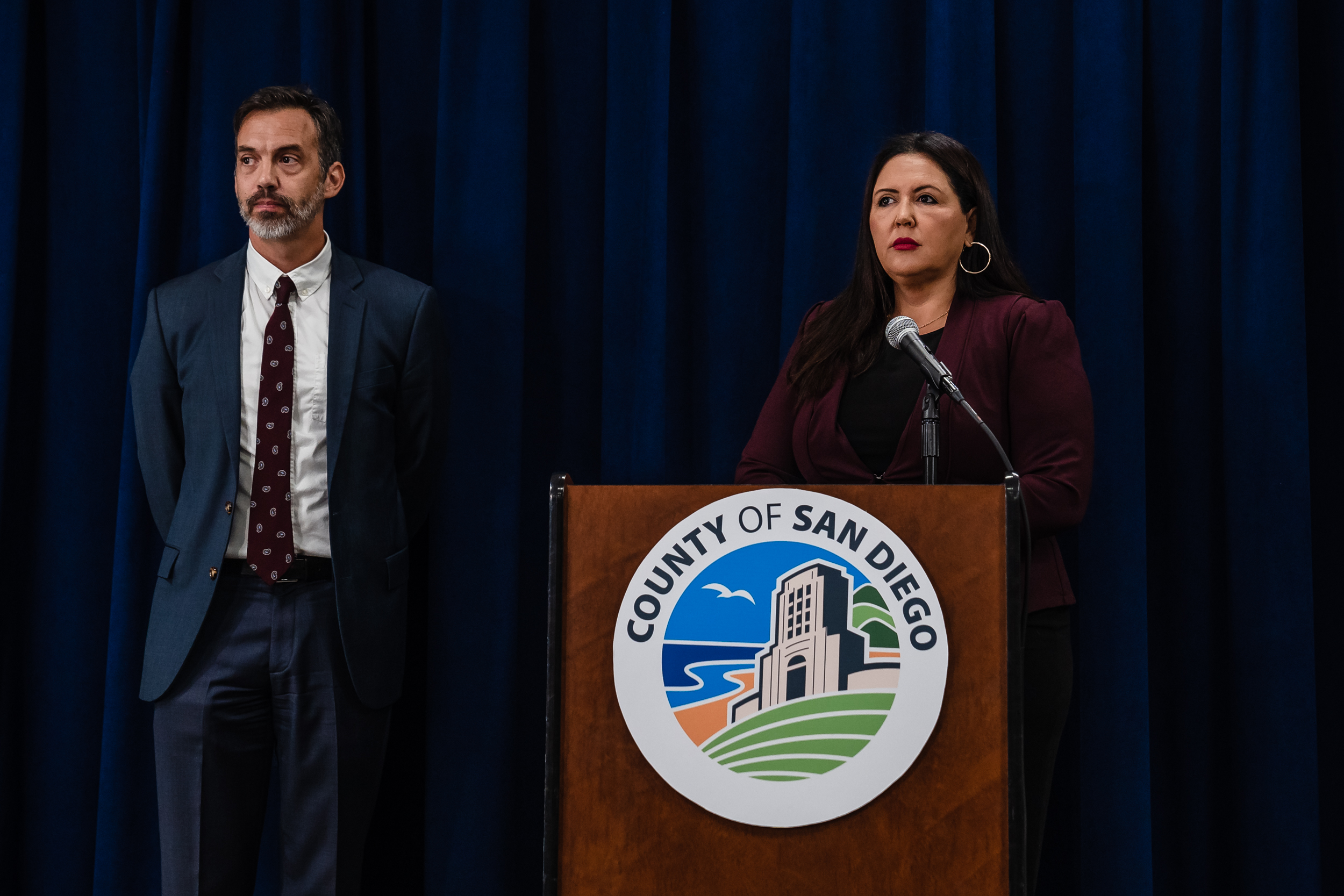
The news: This week, Nora Vargas, the chair of the county Board of Supervisors, expressed reluctance to implement the law. That U-T story is worth a read.
It seems like a normal policy dilemma but it’s potentially the first visible part of a what could be a major dispute between the county and San Diego Mayor Todd Gloria and others. And it could also be an indication of two vastly different approaches to leadership.
In short, could forcing the county, hospitals and area providers to do whatever they had to do to handle the influx of these patients be just what’s needed to force major change or would it be a mess that just leaves people to suffer more than they already do?
Background: The one fact everyone needs to keep grappling with is there is no place for many people suffering with addiction to go. Our Lisa Halverstadt’s seminal piece on the topic came out in September and should remain top of mind for any policy makers dealing with the crisis on our streets. Put simply, if you have a low, or no, income, you depend on Medi-Cal, you cannot get into adequate drug treatment. If you do, it’s like winning the lottery.
This is just bonkers, from Halverstadt’s story:
“While San Diegans with private health insurance and financial means have more treatment options, the county has just 72 withdrawal management – or detox – beds for the nearly 1 million San Diegans with Medi-Cal insurance. These are places where trained workers typically support and keep tabs on people for seven to 14 days while they deal with symptoms such as pain, diarrhea, vomiting and exhaustion. Only two of these detox beds for Medi-Cal patients are in the city of San Diego, which until recently had no beds for these patients.”
The next time you hear someone say that people in the throes of addiction on the street say that they just don’t want help, you can point out that, even if they did, there’s almost nowhere for them to go.
Dr. Margot Kushel of UC San Francisco drove home the point at Politifest as she described her and her team’s massive study of homeless individuals across California.
“I think the most important findings we found was that amongst people who use drugs three or more times a week or drank heavily, 35 percent of them reported currently wanting and trying to get treatment that they had been unable to get,” she said.
She made the point then that it was just political theater to discuss forcing people into treatment when we have so many who want it who can’t get it. Until you exhaust that population of people, why force someone who doesn’t want it into treatment? If they don’t want it, it won’t be effective and it will take the spot of someone who does want it.
Counterpoint: Mayor Gloria and others seem to believe that this kind of push is the only thing that has the promise to vastly increase the number of beds available to people who need them. If you don’t force the county to do it, they never will.
Deep in the U-T piece about the debate, writer Paul Sisson had a great nugget. He had pointed out that Supervisor Terra Lawson-Remer, herself in a tough re-election campaign, agreed with the mayor that the county needed to move forward. And Sisson wrote this.
“Neither Lawson-Remer nor Mayor Gloria’s statements pushing back against deferral directly address assertions that moving forward now would put devastating pressure on ERs. Asked whether the mayor was saying that he believes those assertions are false, a spokesperson said in an email ‘yes, he is.’”
In other words, he’s calling bullshit.
His theory seems to be that even if it provoked a crisis at hospitals, that would force the county to act, much as it did when the federal government just started dropping asylum seekers at transit centers.
And maybe this makes sense. Nothing else seems to have pushed anyone to create the needed beds or support systems. Getting off meth or opioids is no small task. It is extremely painful and leads withdrawal symptoms, discomfort and excretions someone has to manage.
Sen. Jones Wants to Deal

State Sen. Brian Jones came by for a visit with the Politics Report this week and we talked about this briefly.
We discussed the issue of homelessness and drug addiction and he took the expected line that people need to be held accountable and perhaps forced into treatment.
“Either they want to be accountable and get the help or they don’t it want, because there’s a criminal element, there’s a mental illness or drug addiction and they are not capable to make the type of decision to be accountable,” he said.
When I pointed out that there were no spots for people who need help but have Medi-Cal and not private insurance, he said this.
“I’m going to disagree with the no spots because I haven’t talked to them in a while. My understanding is Rescue Mission has spots. California has made it difficult for faith based to work in this environment because of the funding laws they’ve put in place,” he said.
Halverstadt actually talked to the Rescue Mission for her piece I mention above.
Paul Armstrong, the Rescue Mission vice president said it’s so hard for people to get help, providers like him are often unable to get to people in the moments of clarity when they consider trying to get out of the cycle of addiction.
“You have the golden hour. We miss out 99 percent of time,” he said.
More from Jones: He touted his good working relationship with Democrats particularly Toni Atkins, the outgoing Senate president pro tempore. Jones remains minority leader in the Senate.
“We’re both committed to keeping a positive relationship so we can represent San Diego well,” he said.
He feels like maybe the tide is turning a bit as Gov. Gavin Newsom’s poll numbers drag.
“Sacramento is more bipartisan than DC. We love California as much as majority does. We would have a different way of governing it. As voters get more frustrated with the governor, we hope they’ll say ‘These Republicans are avoiding ideological nonsense and we should give them a chance,” he said.
Hope you enjoyed Beef Week. Catch up on all of them here. If you have any feedback or ideas for the Politics Report, send them to scott.lewis@voiceofsandiego.org.
““I’m going to disagree with the no spots because I haven’t talked to them in a wall.”
did you have AI transcribe the quote? i think that should be ‘a while’.
“His theory seems to be that even if it provoked a crisis at hospitals, that would force the county to act, much as it did when the federal government just started dropping asylum seekers at transit centers.” NOTE — it hasn’t been the County or any other govt agency who has taken care of the bulk of these asylum seekers, including 100s in open-air detention camps in the South County, it’s been scores of volunteers and the donors behind them. This has also been the story of unsheltered residents in the City & County for at least a dozen years, with much overlap between the two in terms of volunteers and donors. It’s not sustainable.
The Mayor need to read the Rand Report on California’s shortage of Mental Health beds. It found that at the Acute Level there was a statewide shortage of 1,971 bed. At the Subacute level that shortage rose to 2,796 beds.
https://www.rand.org/pubs/research_reports/RRA1824-1-v2.html
Clarification: this law is for people with untreated serious mental illness, those with addiction, or those with both conditions. It is not just for people with addiction.